Gravity as Guardian: Argonne Explores Power of Passive Safety in Advanced Nuclear Reactors
When a nuclear power plant shuts down, the heat from the reactor doesn’t disappear right away. The fuel continues to
Press Release Disclaimer: This is a press release distributed through the XPR Media network. It has not been independently verified by our newsroom.


When a nuclear power plant shuts down, the heat from the reactor doesn’t disappear right away. The fuel continues to give off what scientists call decay heat. In the event of an unplanned shutdown or accident scenario, the heat must be removed fully, safely and without fail.
This press release features multimedia. View the full release here: https://www.businesswire.com/news/home/20260929102190/en/
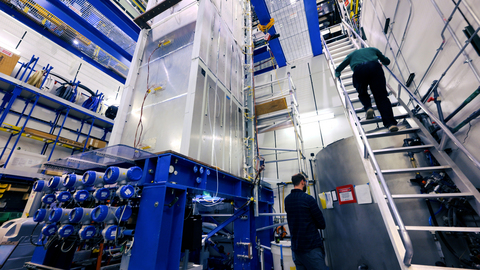
Argonne’s multi-story NSTF allows for study of steam and water flow in nuclear reactor designs given changes in power, pressure, the height of water inlets and more. (Image by Argonne National Laboratory.)
Researchers at the U.S. Department of Energy’s Argonne National Laboratory study ways to remove decay heat without pumps or active controls. They recently looked more closely at how certain systems behave when the amount of decay heat changes over time, just as it does in the real world.
One concept, called the Reactor Cavity Cooling System (RCCS), is being considered for several advanced nuclear reactor designs. Argonne’s Natural Convection Shutdown Heat Removal Test Facility (NSTF) is the largest experimental facility of its kind built to study how such systems work at realistic size and conditions.
The RCCS concept uses passive safety principles – relying on natural phenomena like gravity and buoyancy instead of mechanical pumps — to move water through metal tubes that run around the outside of a reactor vessel. When the reactor shuts down, decay heat travels from the vessel walls into these tubes. Warmer water rises, cooler water falls, and the loop carries heat away to a large storage tank at a higher elevation.
Because the water can eventually start to boil and form steam, engineers must understand not only how much decay heat the system can remove, but also how it behaves when liquid water and steam coexist.
Using the NSTF’s 59-foot-tall loop, the team ran controlled tests at power levels scaled based on the range of typical decay heat levels in a full‑size reactor. They then changed the height of the main water tank inlet, which can change across different designs. The inlet’s height affects how much water is available and how fluid in the loop circulates and flows.
One key effect they observed was a phenomenon called flashing. Flashing happens when water in the lower portions of the loop rises in elevation and reaches a critical point where it turns suddenly into steam, even without extra heat. These bursts of steam – flashing – can affect surges in the flow of water and steam, reducing cooling efficiency and placing extra stress on reactor components..
They found that decay heat at lower power levels slowed the spread of boiling and flashing from NSTF’s tank into its chimney.
The height of the tank inlet also mattered. They identified a clear boundary where metrics changed and concluded that mid-level inlets contributed to more stable operating conditions in certain scenarios.
“These findings have practical value for companies designing next‑generation reactors,” said Argonne nuclear engineer Qiuping Lu.
This research was supported by the U.S. Department of Energy Office of Nuclear Energy’s Advanced Reactor Technologies program.
View source version on businesswire.com: https://www.businesswire.com/news/home/20260929102190/en/
Media gallery